Find your size before you order. Use the relevant chart below and check your chosen product for any specific fit advice.
BJJ Gis · Grappling Shorts · Rash Guards
You don’t need existing fightwear to check your size. Use a measuring tape to take your body measurements, then follow the guidance for your chosen product. The charts below include both body sizing information and garment dimensions.
Measure your height barefoot and record your current body weight. Use both measurements to find your starting size in the BJJ gi chart. The illustrated sleeve span and pant length describe the garment itself. If your height and weight fall into different sizes, contact VHTK for help choosing your fit.
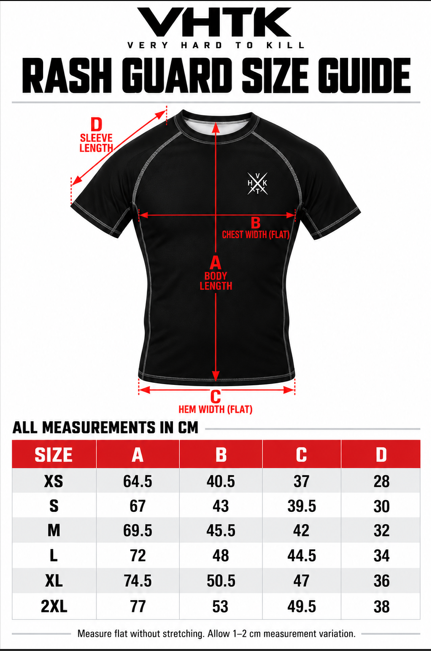
Measure around the fullest part of your chest, keeping the tape level without pulling it tight. The VHTK chart shows the rash guard’s flat dimensions, including chest width, rather than body circumference. If you’re buying your first rash guard, send VHTK your chest measurement and chosen product for sizing help.
Measure around your waist where you normally wear your shorts. Keep the tape level and comfortably snug, then compare your measurement with the waist range in the VHTK fight shorts chart. The inseam and outer length describe how long the shorts are, helping you compare coverage between sizes.

Our white and black uniforms use the same sizing and are available in A1, A2, A3 and A4. Match both your height and weight to the chart. If they fall into different size categories, choose the larger size.
Measurement A shows the sleeve span across the jacket, from one cuff to the other. Measurement B shows the pant length marked in the diagram. These garment dimensions help you assess coverage alongside the chart’s height and weight ranges.
A suitable gi allows you to bend your knees, raise your arms and move your shoulders without strong pulling. Excess fabric can make the fit cumbersome, while a tight jacket or waistband can restrict movement. Consider both coverage and movement when comparing sizes.
Follow the selected gi’s care label when washing and drying. High heat can change the fit of cotton garments. Check the product’s shrinkage guidance before choosing a size, rather than assuming every gi keeps exactly the same dimensions after washing.
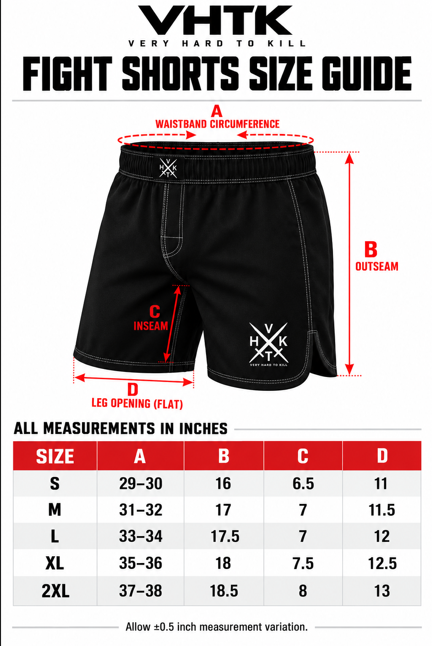
Check your waist measurement against the chart, then compare the listed lengths with training shorts you already wear comfortably. The regular athletic cut provides room through the hips and thighs. An elastic waistband and internal drawstring let you adjust the waist.
The inseam measures from the crotch seam to the leg opening. The outer length measures from the top of the waistband to the hem. Compare both measurements to choose how much thigh coverage your fight shorts provide.
Grappling shorts need room through the hips and thighs for squatting, takedowns and guard work. VHTK’s four way stretch fabric and elastic panel between the thighs support these movements. A suitable fit allows you to lift your knees without the waistband digging in or the fabric pulling tightly.
The internal drawstring adjusts the elastic waistband for a secure fit. Tighten it enough to hold the shorts in position without squeezing your waist. Check the fit while bending and squatting before training.
Gi sizing uses the standard A0–A5 system based on height and weight. Our gis are pre-shrunk, but a small amount of shrinkage on the first few cold washes is normal and expected.
The VHTK rash guard chart lists garment measurements in centimetres. Chest width measures across the garment when laid flat, rather than around your body. Compare the labelled measurement points carefully. Doubling the flat chest width gives the garment’s unstretched circumference, not a recommended body chest size.
A rash guard fits close to the torso without restricting breathing. Raise your arms and reach forward to check for strong pulling across the shoulders or underarms. VHTK’s stretch fabric allows movement, but stretch alone does not make a smaller size suitable.
Body length helps you assess where the hem sits when worn. Check that the rash guard covers your torso as you bend and reach. VHTK’s silicone waistband grip helps reduce riding up, while the correct size provides enough length without excessive bunching around the waist.
Send us the product name and your measurements. We’ll help you compare them with the right chart.